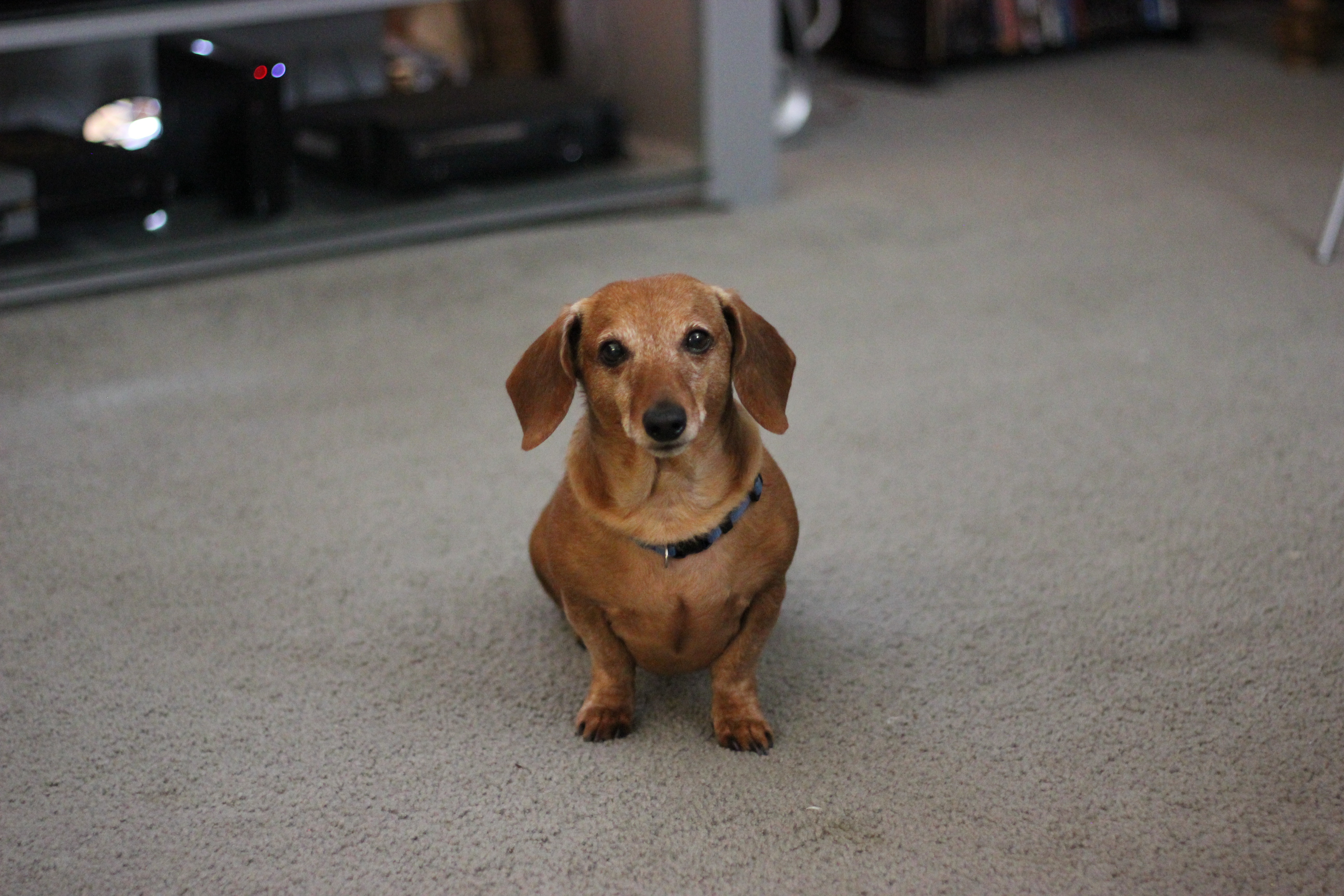
There is a particular stubbornness to a Dachshund that never fully goes away. Even as a senior, they approach the world with the same bold confidence they had as a puppy — nose down, ears flopping, entirely convinced that their compact body is more than adequate for whatever challenge presents itself. The gray around the muzzle arrives quietly. The naps get longer. And yet the personality — opinionated, curious, deeply attached to their person — remains completely intact.
Dachshunds are long-lived dogs, commonly reaching 12 to 16 years with good care. But their iconic long-backed, short-legged body — the very thing that makes them instantly recognizable — carries with it one of the most serious breed-specific health risks in all of dogdom. Understanding that risk, and managing it proactively, is the single most important thing a senior Dachshund owner can do.
"Dachshunds are considered seniors around age 7 to 9. Their chondrodystrophic skeleton makes spinal disease not just possible but probable over a lifetime — and the decisions you make about their daily environment, weight, and activity have a direct impact on how that risk plays out."
IVDD: The Condition That Defines Senior Dachshund Health
Intervertebral disc disease — IVDD — is the most critical health concern for every Dachshund owner to understand. The condition occurs when the cushioning discs between the vertebrae of the spine harden, bulge, or rupture, pressing on the spinal cord and causing pain, weakness, or paralysis. Dachshunds are affected by IVDD at a rate dramatically higher than almost any other breed — studies suggest that up to 25% of Dachshunds will experience a significant disc episode during their lifetime.
The risk accumulates with age. By the time a Dachshund reaches senior years, the discs have endured years of stress from a body design that was never anatomically ideal. A disc that held together at five may not hold together at ten. And because the signs of IVDD can appear suddenly — a dog that was fine yesterday unable to walk today — every senior Dachshund owner should know what to watch for and how to respond.
Early warning signs include: reluctance to jump or climb stairs, crying when picked up or touched along the back, a hunched posture, wobbling or crossing of the rear legs, and in more serious cases, dragging of one or both rear limbs. Any of these signs warrant an immediate veterinary evaluation — not a wait-and-see approach.
⚠️ If your senior Dachshund suddenly loses the ability to walk, shows weakness in the rear legs, or loses bladder or bowel control — this is a spinal emergency. The window for successful surgical intervention is narrow. Contact a veterinary neurologist or emergency clinic immediately — do not wait until morning.
Protecting the Spine Every Single Day
The most impactful thing you can do for a senior Dachshund's spine is eliminate high-impact jumping from their daily life entirely. Every time a Dachshund jumps off the couch, hops out of the car, or launches themselves down a flight of stairs, their long spine absorbs a compressive force disproportionate to their size. Over years, this cumulative impact dramatically accelerates disc deterioration. A dog ramp is not optional for a senior Dachshund — it is spinal medicine.
Dog Ramp for Cars & Furniture
Eliminates the compressive impact of jumping — the single most important piece of equipment for protecting a senior Dachshund's vulnerable spine every day.
For dogs already experiencing spinal discomfort or recovering from a disc episode, a support harness allows you to assist them gently without putting any pressure on the neck or spine — distributing support across the chest and hindquarters instead.
Support Harness for Senior Dogs
Provides gentle lift assistance without spinal strain — essential for Dachshunds with disc disease, rear-leg weakness, or post-surgery recovery.
Weight: The Variable You Control Most
If IVDD is the defining health risk of the Dachshund, excess weight is the accelerant that makes it worse. Every additional pound on a Dachshund's long back increases the compressive load on already vulnerable discs. A Dachshund who is even two or three pounds overweight is carrying a meaningfully higher spinal injury risk than one kept at a lean, healthy body weight.
Dachshunds are food-motivated to a degree that rivals almost any other breed. They are skilled beggars, creative counter-surfers, and entirely without shame when it comes to pursuing food. This makes weight management a constant, active effort — but it is one of the highest-impact health decisions you can make for a senior Dachshund. Measured portions, twice-daily feeding, and a senior-specific food formula are the foundation.
Senior Dog Food — Age-Appropriate Nutrition
Lower in calories, higher in lean protein — formulated to help your senior Dachshund maintain a healthy weight and protect their spine from excess load.
Fresh water access supports kidney function and helps regulate appetite. A pet water fountain keeps water appealing and fresh throughout the day — an easy addition that supports overall health in an aging Dachshund.
Pet Water Fountain — Fresh, Filtered Water All Day
Encourages consistent hydration — supporting kidney health and overall organ function in your aging Dachshund throughout the day.
Joint Health Beyond the Spine
While the spine dominates conversations about Dachshund health, arthritis in the peripheral joints — hips, elbows, and shoulders — is also extremely common in senior dogs of this breed. Their low center of gravity and short legs place unusual stress on the joints with every step, and years of that cumulative load leads to cartilage wear and inflammation that can be just as limiting as spinal disease.
Glucosamine and chondroitin work together to slow cartilage breakdown and support its regeneration — addressing the joint deterioration that makes daily movement painful for an aging Dachshund. Starting supplementation early, well before significant symptoms appear, produces the most meaningful long-term benefit.
Glucosamine for Dogs — Joint Support Supplement
Supports cartilage health and reduces joint stiffness — a foundational supplement for any senior Dachshund's daily wellness routine.
Fish Oil Omega-3 for Dogs
Reduces joint and spinal inflammation at the cellular level — while supporting your senior Dachshund's coat, heart, and immune system simultaneously.
Collagen Supplement for Dogs
Supports the connective tissue and ligaments around aging joints — a valuable addition to a senior Dachshund's joint and spinal health routine.
A Bed Designed for a Long, Low Body
Where a senior Dachshund sleeps matters enormously for spinal and joint health. A flat, worn-out bed offers no support for a dog whose entire skeletal design places stress on the spine — and hours of rest on an inadequate surface add up to a dog who wakes up stiffer and more uncomfortable than they need to be.
An orthopedic memory foam bed provides the even, supportive sleeping surface a senior Dachshund's long back needs — distributing weight across the full length of their body, eliminating pressure points, and allowing the spine and joints to decompress fully during rest. Choose a bed with low entry — a high-sided bed that requires climbing in is itself a spinal hazard for a dog who should not be jumping or scrambling.
Orthopedic Memory Foam Dog Bed
Provides full-length spinal support for a senior Dachshund's long body — reducing pressure, easing joint discomfort, and improving rest quality every single night.
Creating a Spine-Safe Home
The home environment of a senior Dachshund needs to be designed around their spinal vulnerability. Slippery floors are a particular hazard — a Dachshund who scrambles to recover from a slip puts significant rotational and compressive force through their spine in the process. Non-slip mats throughout the home create safe footing and eliminate that risk entirely.
Non-Slip Rug Mats
Creates safe, confident footing on slippery floors — preventing the scrambling slips that put dangerous rotational force through a Dachshund's vulnerable spine.
Rug Grip Tape
Keeps rugs firmly in place so they don't slide or bunch — preventing the sudden slips that can trigger a spinal episode in a senior Dachshund.
Stairs are another significant hazard — both going up and coming down place compressive load on the Dachshund's spine. Where possible, block access to stairs or carry your Dachshund rather than letting them navigate independently. For getting in and out of the car, a ramp is non-negotiable. A pet camera lets you monitor their activity and movement when you're not home — catching any signs of sudden weakness or distress early.
Pet Camera with Two-Way Audio
Monitor your senior Dachshund's movement and behavior while you're away — catching early signs of spinal distress before they become emergencies.
Cognitive Decline and the Senior Dachshund Mind
Dachshunds are sharp, curious, and mentally active dogs — and that doesn't fully change with age. But cognitive dysfunction syndrome does affect a meaningful proportion of dogs over 11, and Dachshunds are no exception. Signs include disorientation, forgetting learned behaviors, nighttime restlessness, staring at walls, and changes in social interaction. A soft night light near their sleeping area can significantly reduce the nighttime anxiety and confusion that often accompanies cognitive decline.
Soft Night Light
Reduces nighttime disorientation and anxiety in senior dogs with cognitive changes — a gentle, simple addition that makes nights significantly calmer.
Puzzle toys provide gentle mental stimulation that keeps an aging Dachshund's sharp mind engaged — reducing boredom-driven anxiety and helping maintain cognitive sharpness well into the senior years. Choose toys that reward their natural scent-hunting instincts for maximum engagement.
Dog Puzzle Toy — Mental Enrichment
Keeps your senior Dachshund's curious, tenacious mind engaged — the perfect low-impact enrichment for a dog whose brain never really slows down.
Natural Support: What Many Dachshund Owners Are Exploring
Hemp-derived CBD has become one of the most discussed natural wellness options for senior dogs in chronic pain — and Dachshund owners are among the most active in exploring it. Given the breed's high prevalence of spinal discomfort, joint inflammation, and the anxiety that often accompanies pain and sensory decline, hemp oil's potential anti-inflammatory and calming properties make it a natural fit for many senior Dachshunds. Many owners report meaningful improvements in their dog's comfort and restfulness with consistent supplementation.
If you're considering whether hemp oil might benefit your senior Dachshund, we've put together a comprehensive, honest guide covering exactly how it works, what to look for in a quality product, and what every pet parent should know before starting.
Hemp Oil for Senior Dogs: What Pet Parents Should Know
A complete, honest guide to hemp oil for aging dogs — what it is, how it works, what to look for, and how it may support your senior Dachshund's comfort and quality of life.
"A senior Dachshund is still, at their core, the same bold little dog who thought they could take on the world at six months old. The body asks for more care now. The spirit has not changed one bit. Your job is to protect that body so the spirit can keep doing what it does."
Dachshunds are warriors in a long, low package. They age with attitude, with humor, and with a devotion to their person that never wavers. The challenges they face — the spine above all, the joints, the weight — are real and require consistent attention. But they are manageable challenges for an owner who understands them.
Every ramp, every non-slip mat, every supplement and measured meal — they add up to a senior Dachshund who moves with less pain, sleeps with more comfort, and lives the long, full life this remarkable breed is capable of. That stubborn spirit deserves nothing less.